
South Korean showbiz is nothing new to me; I deal with it in my academic work. That’s why I wasn’t completely shocked by the show Duel of the Fates, which has been streaming on Disney+ since the beginning of this year. However, there were a few thought-provoking moments, and I don’t regret the time I spent exploring this format.
The reality show (game show?) is based on a clash of 49 shamans (mudang), tarot readers, saju experts, and many other professions related to “fortune-telling.” Over several rounds, they were tasked with proving the effectiveness of their skills, which ultimately determined the winner of the entire program. The mere fact that such a show was created didn’t surprise me – after all, we are already past two seasons of Possessed Love, a dating show where the participants, who are also broadly understood “fortune tellers,” have to find love. South Korea loves competitive reality shows, and we’ve been observing a resurgence of interest in spirituality for some time now, so the creation of The Battle of Fates was only a matter of time. Even so, I watched the program with curiosity, looking closely at cultural and social issues, as well as those related to energy work itself.
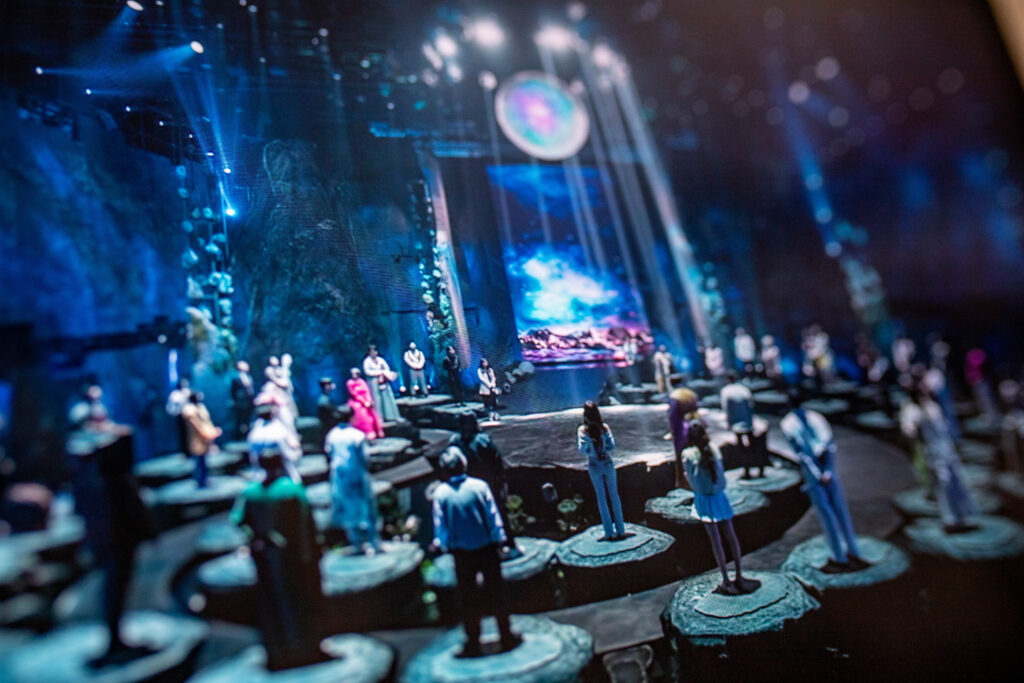
It’s worth sketching the context first. Korean shamanism (musok) is very deeply tied to the culture, but for hundreds of years, it was marginalized, and its followers were persecuted (especially during the Japanese occupation). To this day, shamanism is banned in North Korea. It wasn’t until the 1970s that we started to see shamanism being brought back into favor and even recognized as one of the pillars of intangible cultural heritage. However, this is not a universally accepted approach. Shamanism is still perceived as a superstition – especially by Catholics and Protestants. There has also been no shortage of controversies that have hurt shamanism’s PR, the most globally famous of which is probably the one involving former president Park Geun-hye. Her friend, Choi Soon-sil, dubbed the “Korean Rasputin,” allegedly influenced Park’s decisions by using supposed spiritual practices. Although authentic shamans emphasized that Choi’s activities had little to do with being a mudang, it was a catchy enough tagline in the public eye to equate shamanism with manipulation. On the show, we also see tarot masters (which doesn’t need explaining to a “Western” viewer), but also experts in saju (a system rooted in Chinese philosophy and based on the lunar calendar) or people who read faces or feet.
When I first heard about this show, I had my doubts about participating in productions where it’s clear the contestants want to gain money and fame. I didn’t quite understand how one could work with ancestor spirits, for example, with the intention of winning a TV show. It seemed almost offensive to me. And while it’s hard to tell whether the participants genuinely didn’t care about material matters, to this day I remember a scene where one of the shamans clearly states that even though it wasn’t the assignment (the goal was to pinpoint a single ailment of a person standing before them without any additional information), she must, in accordance with her true self, list everything she sees to be able to help this person. By doing so, she lost the challenge. She referred to the ethos of shamanic work and emphasized that physical ailments are never isolated problems but part of a larger whole that must also be looked at. After these words, she received a loud round of applause from her fellow contestants. Both this scene and the participants’ statements at other moments proved to me that one of the driving reasons for entering the program was the desire to show the world what they do, how much power it holds, and how much it is needed. A lot of support was visible in the interactions between the participants. Despite the competition going on between them, the contestants appreciated the craft and experience of others, expressed a desire to use the services of their “opponents” themselves, and what truly resonated was a community of shared experiences – especially the difficult ones.
Another important observation for me was the fact that very different paths can lead to similar results. Already while watching Possessed Love, I had a lot of thoughts about why there are so many shamans in Korea specifically (not only in Korea, of course, but I naturally compared it to Poland). For me, it was confirmation that, to a large extent, we work with energy in ways that allow our human minds to even grasp what is happening. Korea is culturally immersed in Confucianism, and consequently in ancestor worship, which makes it much easier for Koreans to work with the energy of “grandpas” and “grandmas.” We receive information in a way that allows us to best understand and interpret it – there is no single truth or only one right way here. People working with tarot cards or face reading received very similar information, which shows that generally, there is no better or worse way to work with energy, with a small asterisk.
I apologize in advance for the spoiler – only shamans made it to the final, and I think that, despite everything, there is one thing that can grant greater access to energy, and that is tradition and practice. The calling to this path is most often received by people who have other shamans in their immediate family. The documented history of musok dates back to the 12th century, a period even before the unification of Korea. Although, as I have already written, shamanism did not enjoy a very good reputation, stories, traditions, and rituals have been passed down from generation to generation for centuries. The fact that Korea is located on a peninsula helped preserve these traditions within one territory, despite the region’s turbulent history. In Poland, traditions related to spirituality and magic have been severed from the lands they originate from. This was influenced by many factors, from tribal dispersion and the role of migration and Christianity, to the oral traditions of the ancient Slavs (instead of written ones) and the glorification of foreign cultures and beliefs. The effect, however, is that most of us have no contact with native practices or traditions (at least not consciously, because we still repeat a lot of sayings, beliefs, and superstitions). There seems to be a lot of truth in the idea that if enough people believe in the same thing and practice it in a similar way, the ritual itself gains more power (hence the surprising effectiveness of social media trends, e.g., the dancing cows on TikTok that you’re supposed to post on the first day of the month to ensure prosperity). Different times, different rituals.
Another thing that wasn’t a surprise but resonated loudly in The Battle of Fates is the lack of mental health support in South Korea. The jury, the participants themselves, and the people who appeared in individual challenges all emphasized how much they lacked the opportunity to “vent,” to be heard, to get some advice, or simply to consciously touch upon a topic. On more than one occasion, I had the impression that the challenges they came with should have been addressed during therapy, as a process, and not during a one-off meeting with a shaman or a saju expert on TV (or at least both). Ultimately, the client goes home later and is left all alone with it. For years, South Korea has been at the forefront of countries with the highest suicide rates. With such a dismal state of psychological care and the continuous stigmatization of using it, the popularity of “fortune tellers” is not surprising.
The final observation, which was also explicitly expressed by the participants in the last episode, is the confirmation that fate can be changed. Although this is something I believe in myself and see in my own work during sessions, we obviously don’t have any research here that could confirm it, which is why the insights of others in this regard are so interesting. Almost all participants agreed that there are situations written in our destiny, but how we react to them depends entirely on us, thanks to which thousands of scenarios and paths open up before us.